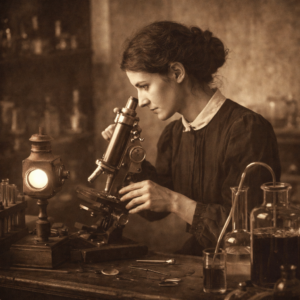
Some time ago, I found myself near a group of teenagers who were preparing for a biology exam. They were talking about who discovered the structure of DNA. I was pleasantly surprised that, in addition to the Nobel laureates Watson and Crick, they also mentioned Rosalind Franklin, whose work Watson and Crick built upon without ever properly crediting her. My biology textbooks never mentioned her. I only learned about her by chance, through some of those lists that name notable women in history, which are often published around Women’s Day.
Speaking of those lists of notable women, they usually frustrate me. Why? They typically contain barely ten to twelve names, and instead of focusing on scientists and inventors, they tend to focus on entertainers. A couple of the most famous female scientists—Marie Curie or Hildegard von Bingen—are usually added almost as an afterthought. Or Lady Godiva, who entered history partly through courage and compassion, but more so through nudity (which is, in fact, largely a myth). This creates the impression that there were barely any women who left a mark on history through their intellectual work, courage or leadership.
In recent years, however, on social media (they do occasionally serve a good purpose), name after name has begun to surface—so many names I had never heard before. So many women whose intellect and courage overcame legal and social barriers, brainwashing from an early age, ridicule, closed doors, threats, and violence. (Mozart’s sister, among countless others, was not so fortunate.) Many were self-taught because no one was willing to teach them. Historians nevertheless tried to erase many of them from public memory—and nearly succeeded. Their work was often stolen. Yet traces remained, in photographs and in “mislaid” documents. Some sharper minds noticed this and began bringing them back into the light.
This is a long list, but still only a beginning. All of these extraordinary women in history deserve at least a few pages each, but I must limit myself to just the most basic information. I do, however, recommend looking up their stories online. They are all deeply inspiring and deserve to have films made about them.
While reading, keep in mind that what is natural, does not have to be enforced. if it was “natural” for women to be mostly mothers and servants, it wouldn’t require so much violence, laws, religion, theft and other sabotage to keep them back.
Ada Lovelace: An English mathematician and writer widely regarded as the first computer programmer, at the time when her society viewed high-level mathematics as physically and mentally damaging to women. She recognized the potential of Charles Babbage’s mechanical general-purpose computer (the Analytical Engine) and wrote the first algorithm intended to be processed by a machine.
Agnes Meyer Driscoll: A cryptanalyst who was critical to breaking codes used by the Japanese Navy during World War II. Her work on deciphering the complex cipher systems of the Japanese was instrumental in the U.S. Navy’s intelligence efforts.
Agnes Pockels: A chemist who was a pioneer in the field of surface science (specifically surface tension) despite having no formal university education. Lacking access to university laboratories or formal education because of her gender, she resorted to conducting world-class research using kitchen pans and homemade equipment.
Aída de Acosta: the first woman to fly a powered aircraft solo—six months before the Wright brothers’ famous flight. She flew Alberto Santos-Dumont’s dirigible from Paris to Neuilly. Despite her technical skill, her parents were so embarrassed by the “publicity” of a woman flying that they swore her to secrecy for 30 years, nearly erasing her from history.
Alice Ball: An African-American chemist who developed the “Ball Method,” the most effective treatment for leprosy in the early 20th century. Her oil injection treatment was used successfully on thousands of patients for decades until antibiotics were developed. She died very young and her discoveries were long credited to another.
Alma Karlin: A writer, poet, and world traveler who spent eight years traveling solo around the globe between 1919 and 1927. She financed her travels by writing articles and painting, becoming a celebrated and unique figure in her time. She faced extreme social ostracization and constant financial instability as a solo female traveler.
Amelia Peabody: An architect who collaborated with Maria Telkes on early solar-powered housing projects. She was instrumental in the architectural and practical application of solar energy principles in building design.
Anna Julia Cooper, Dr.: An author, educator, and civil rights activist who was one of the first Black women to earn a Ph.D. in history (from the Sorbonne in 1924). She is regarded as one of the most prominent African-American scholars in United States history. She had to overcome the dual barriers of Jim Crow segregation and gender discrimination to secure her education.
Antoninette Brown Blackwell: She challenged the chauvinistic scientific theories of Charles Darwin, which she meticulously and thoroughly refuted in her book The Sexes Throughout Nature. In addition, she fought for civil rights and became the first woman to be ordained as a Protestant minister in the United States in 1853.
Aphra Behn: A playwright, poet, and novelist of the Restoration period, making her one of the first professional female writers in English literature. Her works often challenged contemporary social norms. She was frequently dismissed by critics who claimed her writing was “improper,” and she even served time in debtors’ prison after being abandoned by the government she served as a spy.
Asima Chatterjee: She pioneered research on vinca alkaloids, which are used today in chemotherapy to treat epilepsy and malaria. Despite working with extremely limited funding and equipment in colonial and post-colonial India, she successfully developed anti-epileptic and anti-malarial drugs from medicinal plants.
Aspasia of Miletus: one of the most brilliant intellectuals of Ancient Athens, despite a society that excluded women from public life, education, and property ownership. Although she was persecuted and put on trial for her influence and free-thinking, she became a central figure in philosophical and oratorical life, opening a school for rhetoric, philosophy, and politics. Plato and Plutarch regarded her as the author of the most famous speeches of the powerful statesman Pericles. She was also a teacher to Socrates, thereby directly shaping the ideology of Athenian democracy.
Barbara McClintock: A scientist and Nobel laureate who discovered the phenomenon of “jumping genes” (transposons) in maize, revealing that genes are not fixed but can move within the genome. Her work revolutionized the understanding of heredity and genetic change.
Camille Claudel: A renowned 19th-century sculptor known for her dramatic and expressive bronze and marble works. She suffered from the theft of her artistic ideas by her mentor, Rodin, and was eventually forcibly committed to a psychiatric asylum by her family, which destroyed her career.
Carol Greider: A molecular biologist who shared the 2009 Nobel Prize in Physiology or Medicine for discovering how chromosomes are protected by telomeres. Her work helped illuminate the mechanisms of aging and cancer.
Cartimandua: A Queen of the Brigantes tribe in ancient Britain during the 1st century AD. To protect her state from Roman conquest, she relied on intelligence, strategy, and negotiation rather than rushing into battle. In doing so, her greatest obstacle was often her own people.
Caterina Sforza: A formidable Italian Renaissance noblewoman who was an illegitimate descendant of the Medici family. She was renowned for her military skill and political ruthlessness in defending her territories, earning the nickname “The Lioness of Forlì.”
Cecilia Payne: An astronomer who, in her 1925 Ph.D. thesis, established that the stars are composed primarily of hydrogen and helium. Her findings were initially dismissed but are now considered the foundational discovery of modern astrophysics.
Chien-Shiung Wu: An experimental physicist who conducted the “Wu experiment,” which provided the definitive proof that the law of parity was violated during weak nuclear interactions. She was controversially excluded from the 1957 Nobel Prize awarded to her colleagues for the related theoretical work.
Edith Sitwell: An eccentric and influential poet and critic known (and mocked) for her distinctive style and modernist aesthetic in the early to mid-20th century. Her work often experimented with sound and rhythm.
Eglantyne Jebb: A social reformer and founder of the organization Save the Children in 1919. She was a key figure in advocating for children’s rights internationally and drafted the Declaration of the Rights of the Child, later adopted by the League of Nations. She was arrested and faced public condemnation for distributing “subversive” leaflets during the war as she fought to provide aid to starving children in “enemy” nations.
Elara Cunningham: A visionary 19th-century inventor who lived as a social outcast in Scotland, where her advanced storm-prediction machines were dismissed as witchcraft by superstitious villagers. During a catastrophic 1913 storm, her inventions successfully guided a doomed ship to safety, yet she was met with further accusation rather than gratitude. She died in isolation, but her posthumously discovered research proved she had pioneered technologies like wave buoys and pressure-based sirens decades before their time.
Eleanor Graves: After growing up in extreme poverty, Dr. Eleanor Graves overcame immense hardship to become a pediatrician dedicated to serving the most vulnerable children in East London. Through her charity “The Bread of Dreams,” she spent decades providing food, medicine, and warmth to those in need, transforming her own childhood hunger into a lifelong mission of compassion.
Eleanor Raymond: An architect who worked with Maria Telkes to design the “Dover Sun House,” one of the first modern homes heated entirely by solar energy.
Eliza Pinckney: An American agricultural pioneer who revolutionized farming in the South Carolina colonies. She successfully developed and promoted indigo production as a major cash crop, significantly boosting the region’s economy.
Elizabeth Blackburn: A Nobel laureate who co-discovered the molecular nature of telomeres, which protect chromosomes. She also co-discovered the enzyme telomerase, which replenishes the telomere, fundamentally advancing the understanding of cancer and aging.
Elizabeth Lee Hazen: A microbiologist who, with Rachel Fuller Brown, co-developed the antifungal drug Nystatin. Her laboratory work in isolating and testing cultures was crucial to developing the world’s first effective medical treatment for dangerous fungal infections.
Elizabeth Packard: A mental health reformer who was unjustly committed to an asylum by her husband for disagreeing with his religious views. Upon her release, she successfully campaigned for laws protecting the rights of married women and regulating the commitment of individuals to psychiatric institutions.
Emma Lilian Todd: An inventor and early aviation pioneer who was the first woman in the world to design and build her own aircraft. Her designs were crucial to early flight technology. Despite being a master designer, she was initially barred from flying her own aircraft at public exhibitions.
Émilie du Châtelet: A mathematician, physicist, and author during the Age of Enlightenment. Her most lasting contribution was translating Isaac Newton’s Principia Mathematica into French, which included her own extensive commentary and corrections, making Newtonian science accessible across the continent.
Enheduanna: A high priestess of the Sumerian moon god Nanna in Ur, who lived around the 23rd century BCE. She is generally considered the first named author (regardless of gender) in recorded world history, known for her powerful temple hymns and poems.
Fatima al-Fihri: A 9th-century visionary and philanthropist who founded the University of al-Qarawiyyin in Fez, Morocco, in 859 CE. It is recognized by UNESCO and Guinness World Records as the oldest continually operating, degree-granting university in the world. Her legacy established the very model of the modern university, yet her name is rarely mentioned in the history of global education.
Florence Parpart: An inventor who improved upon the early refrigerator design in the 1900s. She had to fight to receive patents for her improved and refined designs for refrigerators that were adopted for modern home use.
Forough Farrokhzad: One of Iran’s most influential modern poets and a filmmaker. Her single film, The House Is Black (1963), is a powerful documentary about a leper colony and is considered a foundational masterpiece of Iranian cinema. She was subjected to intense social scandal, the loss of custody of her son, and literary censorship by a traditionalist society that viewed her art as immoral.
Frances Arnold: She was a chemical engineer who pioneered the methods of directed evolution to create new enzymes. Her work is foundational to green chemistry and the development of sustainable fuels and pharmaceuticals. After facing years of skepticism, she finally won the Nobel Prize in Chemistry in 2018.
Frances Glessner Lee: A self-taught forensic scientist who pioneered forensic science in the U.S. She created the “Nutshell Studies of Unexplained Death,” highly detailed miniature dioramas of crime scenes, which are still used today to train criminal investigators. Despite her genius, she was barred from attending Harvard.
Gertrude Elion: A biochemist and pharmacologist who pioneered the “rational drug design” method, leading to highly effective treatments for leukemia, herpes, and AIDS. She was initially rejected for laboratory jobs because employers feared she would be a “distraction” to the men and was told there was no place for women in chemistry.She persisted and eventually won the Nobel Prize in Medicine in 1988.
Gladys West: An African American mathematician who contributed to the mathematical modeling of the shape of the Earth (the geoid), which was foundational to the development of the Global Positioning System (GPS). Her work was crucial for calculating accurate satellite orbits.
Grace Hopper: A computer scientist and Navy rear admiral who was one of the first programmers of the Harvard Mark I computer. In spite of initial dismissal, she is credited with inventing the first compiler, which translated written instructions into computer code, making programming accessible to a wider audience.
Hedy Lamarr: Most people only heard of her as a movie star; few know her as a brilliant inventor. Fighting dismissal and prejudice, she co-developed an early version of frequency hopping spread spectrum technology intended to guide torpedoes during WWII, a principle that is now foundational to Wi-Fi and Bluetooth.
Hertha Ayrton: A engineer, mathematician, and inventor who was a pioneer in electrical engineering and physics. She was the first woman to be nominated for the British Fellowship of the Royal Society for her work on the electric arc and ripples in sand and water. The Royal Society refused to admit her in spite of that, explicitly stating that because she was a married woman, she had no legal standing.
Hildegard of Bingen: A 12th-century abbess, polymath, and mystic. She is one of the first known female composers and wrote extensively on theology, botanical medicine, and natural history. Her scientific works, Physica and Causae et Curae, cataloged hundreds of plants and animals for medicinal use.
Hypatia: A Neoplatonist philosopher, astronomer, and mathematician who lived in Alexandria (Egypt) in the 4th and 5th centuries AD. She was a prominent thinker and teacher in the great intellectual center of the ancient world. She was brutally murdered by a mob of religious extremists who viewed her scientific teaching and political influence as a threat to their dogma.
Ida Tacke Noddack: A chemist and physicist who co-discovered the element Rhenium. More controversially, she was the first to propose the concept of nuclear fission in 1934, although her work was ignored until Lise Meitner later confirmed the theory.
Jadwiga of Poland: The first female monarch of the Kingdom of Poland, reigning from 1384 until her death. Known for her diplomatic skill, she personally oversaw the unification of Poland and Lithuania and greatly supported the University of Kraków.
Jane Cooke Wright: A cancer researcher and surgeon who pioneered chemotherapy techniques and standardized patient testing for cancer drugs. She co-developed the technique of using human tissue culture to test the effects of drugs on cancer cells.
Janet Lane-Claypon: she revolutionized medicine by conducting the first-ever case-control study, using meticulous statistical comparison to identify the initial known risk factors for breast cancer. Her 1926 report transformed the disease from a misunderstood mystery (often attributed to „moral failings”) into a measurable biological problem and established the foundational methodology for all modern epidemiology.
Jennifer Doudna: undeterred by a counselor who told her “girls don’t do science,” Jennifer Doudna co-developed (with Emmanuelle Charpentier) CRISPR-Cas9, a revolutionary tool that allows for the precise editing of genetic code. After her discovery earned her the Nobel Prize, she became a leading global voice for scientific ethics, fighting to ensure this powerful technology is used to cure diseases rather than for irresponsible or “designer” purposes.
Jewel Plummer Cobb: A biologist and cancer researcher who focused on the relationship between genetics and skin cancer. She was also a tireless advocate for increasing the participation of women and minority students in the sciences and higher education. She was frequently denied access to research facilities and fellowships due to racial quotas and gender bias.
Joan Clarke: A cryptanalyst and numismatist who worked at British Bletchley Park during the Second World War. She was part of the small team led by Alan Turing that successfully cracked the German Enigma code, significantly aiding the Allied war effort. Shewas officially classified as a “Linguist” because the rank of “Cryptanalyst” was reserved for men.
Jocelyn Bell Burnell: While working as a graduate student, she discovered the first four pulsars by meticulously analyzing miles of paper data from a telescope she helped build, identifying a “scruff” that others dismissed as noise. Her supervisor was awarded the 1974 Nobel Prize for the discovery while she was excluded.
Josephine Cochrane: An inventor who patented the first practical, mechanical dishwasher in 1886, establishing the foundation of the modern appliance industry.
Juana Inés de la Cruz: A self-educated writer and scholar in colonial Mexico during the 17th century. The Viceroy of New Spain noticed her knowledge when she was 16. He was skeptical about it, so he gathered 40 scholars to interrogate her without allowing her to prepare. She left them speechless. Today she’s considered one of the greatest writers of the Spanish Golden Age. She was eventually forced by the Church to stop writing altogether as punishment for her “unfeminine” pursuit of knowledge.
Judith Love Cohen: An aerospace engineer who worked on the Hubble Space Telescope and designed the Abort Guidance System (AGS) used on the Apollo 13 mission.
Julia Morgan: she overcame repeated rejections based on her gender to become the first woman to study architecture at the École des Beaux-Arts and the first licensed female architect in California. In her work, she favored rigorous technical precision over public recognition. She became a legend because of how her buildings survived the 1906 San Francisco Earthquake.
Karen Horney: A psychoanalyst who founded neo-Freudian psychology and challenged many of Sigmund Freud’s theories on female development. For those challenges, she was ostracized and stripped of her teaching positions.She emphasized the role of culture and social relationships in shaping personality and neurosis.
Katharine Burr Blodgett: A physicist and chemist who was the first woman to receive a Ph.D. in physics from Cambridge University in 1926. She invented non-reflecting “invisible” glass by developing chemical films only one molecule thick, which is still used today in lenses and window displays. Despite her Ph.D., she was often treated as a lab assistant rather than a researcher.
Katie Hinde: she revolutionized our understanding of breast milk by proving it is a sophisticated communication system, not just passive nutrition, that adapts its chemical composition in real-time to a baby’s sex, health, and environment. Her research revealed that mothers’ bodies “read” infant saliva to produce custom antibodies and hormones that shape a child’s temperament and immune system, uncovering a biological dialogue that had been ignored by scientific establishment for decades as „not important enough”.
Kubaba or Kug-Bau (c. 2400 BCE): Originally a “tavern-keeper” (a high-status role involved in the brewing of beer, which was a sacred and scientific process in Mesopotamia) she rose to become the Queen of Kish. She is referred to as lugal (king), rather than queen, which clearly indicates that she ruled independently and sovereignly. Some sources suggest that she was also a warrior, and that her power stemmed from her ability to defend the city during a time of instability. Her leadership was so successful that she was later deified in Neo-Hittite culture as a protective goddess.
Lalla Fatma N’Soumer: A 19th-century Algerian resistance leader and visionary who led the struggle against French colonial invasion in the 1850s. Known as the “Joan of Arc of Kabylia,” she was a brilliant tactical strategist who commanded a force of both men and women in the mountains of Algeria. After her capture, she was imprisoned by the French until her death and her role was diminished by historians.
Laskarina Bouboulina: A Greek naval commander and heroine of the Greek War of Independence in the early 19th century. She commanded her own fleet of ships, financed the war effort with her personal fortune, and played a crucial role in blockades and battles.
Lila Hart: A pioneering nurse who, despite being socially shunned for her low social status and forced into survival on the margins of a mining town, saved dozens of lives during a devastating winter fever and a subsequent mining disaster. She dedicated her life to serving forgotten populations in free clinics and children’s wards.
Lilian Gilbreth: A psychologist and industrial engineer who was a pioneer in applying psychology to industrial management and efficiency. She had excellent results, but after her husband died, she lost most of her consulting contracts. To feed her 12 children, she had to turn to designing kitchen appliances, where she was also very innovative.
Lise Meitner: A physicist who played a key role in the discovery of nuclear fission. She was the first to explain the theoretical basis of how the uranium nucleus splits into smaller parts, though she was controversially overlooked for the Nobel Prize.
Lou Andreas Salomé (Luíza Gustavovna Salomé): an intellectual who famously rejected marriage proposals from philosophers like Nietzsche and Rée to pursue a life of absolute personal and academic freedom, often facing mockery and slander. Many believe that she was the inspiration for the character of Zarathustra in Nietzsche’s iconic work Thus Spoke Zarathustra. She wrote more than ten novels and numerous academic essays, then became one of the first female psychoanalysts at age 50. She challenged Freudian ideas, for which she was shunned by her colleagues. Nevertheless, she continued to publish groundbreaking work well into her 70s.
Lynn Margulis: A evolutionary theorist and biologist who developed the endosymbiotic theory, which explains that complex cells (eukaryotes) evolved from a symbiotic relationship between simpler cells. This theory fundamentally reshaped modern biology. Her theory was widely mocked as “insane” before it was eventually proven correct.
Margaret Belle Oakley: a quantum chemist who founded the field of bioinformatics. She created the first comprehensive digital database of protein sequences and invented the universal one-letter amino acid code, a “scientific language” still used by every molecular biologist today. Despite being dismissed during her era by those who viewed data management as clerical rather than innovative, her development of PAM matrices and sequence comparison tools provided the essential foundation for the Human Genome Project and modern personalized medicine.
Margaret Knight: An inventor who earned several patents, most notably for a machine that automatically produced flat-bottomed paper bags. She won a legal battle to defend her patent against a Charles Annan, who stole her workand tried to discredit her based on her gender.
Maria Goeppert Mayer: A theoretical physicist who developed the nuclear shell model of the atomic nucleus. For much of her career, she was forced to work as a “volunteer” with no pay.
Maria Orosa: A food scientist, pharmaceutical chemist, and war heroine during World War II. She invented many Filipino staple foods, designing them for maximum nutritional efficiency. After Japan occupied the Philipines, she organized smuggling such foods to starving war prisoners, and is credited for saving thousands of lives.
Maria Sibylla Merian: A 17th-century naturalist and scientific illustrator. At a time when insects were considered “beasts of the devil” that arose from spontaneous generation, she meticulously documented the process of metamorphosis, proving that insects hatched from eggs and transitioned through specific stages. In 1699, at the age of 52, she traveled to Suriname on a self-funded expedition to study tropical species. Her work, Metamorphosis Insectorum Surinamensium, laid the groundwork for modern entomology.
Maria Telkes: A biophysicist and solar energy pioneer. She designed the Dover Sun House and developed the first practical thermoelectric generator that used solar power. She was fired from an MIT project after colleagues sabotaged her solar house design and then blamed her. Yet she came to be known as “The Sun Queen.”
Marian Croak: A computer scientist who pioneered the development of Voice over Internet Protocol (VoIP) technology. She holds over 200 patents, many related to advancing the way we use the internet for voice and data communication.
Marianne North: A Victorian artist and botanist who traveled the world, often through unexplored regions such as the Amazon and Australia, documenting plants with extraordinary precision. Although her work was frequently dismissed or attributed to others, she ultimately established her own collection at Britain’s Kew Gardens.
Marie-Sophie Germain: A highly talented mathematician, physicist, and philosopher who made significant contributions to elasticity theory. Her work was instrumental in calculating the complex vibrational patterns of elastic surfaces, such as those found in structures like the Eiffel Tower. She had to steal her brother’s identity to study at the École Polytechnique and was initially denied her prize from the French Academy of Sciences.
Marie Tharp: A geologist and oceanographic cartographer who, alongside Bruce Heezen, created the first comprehensive map of the ocean floor. Her work was instrumental in proving the theory of continental drift by identifying the Mid-Oceanic Ridge. She was barred from going on research ships for years and her groundbreaking maps were initially dismissed as “girl talk.”
Marthe Gautier: A pediatrician/researcher who played a crucial role in identifying the chromosomal abnormality that causes Down syndrome (Trisomy 21). She was controversially sidelined in the recognition of the discovery.
Mary Edwards Walker: An abolitionist, prohibitionist, and surgeon who served in the Union Army during American Civil War. She is the only woman to have ever received the Medal of Honor, which was awarded for her wartime services. She was arrested multiple times for wearing “men’s clothes” and had her Medal of Honor revoked by the government, though she refused to return it.
Mary Harris Jones: A schoolteacher and dressmaker who became a prominent labor and community organizer, known widely as “Mother Jones.” She successfully organized miners, children, and labor movements across the United States in the late 19th and early 20th centuries. She was frequently arrested, threatened with death, and labeled “the most dangerous woman in America” by corporations.
Mary Somerville: A scientist and writer in the 19th century who popularized mathematics and astronomy. She was nominated to be the first female member of the British Royal Astronomical Society (alongside Caroline Herschel). She had to hide her library books from her father, who feared that too much studying would cause her mind to “crack” under the strain.
Mary Walton: An inventor who obtained patents for two notable inventions: a device for extinguishing chimney fires and a system for dampening noise on railroad tracks. Her railroad dampening system was widely used to reduce noise pollution.
Mary Wortley Montagu: A writer, poet, and aristocrat who is remembered for introducing the practice of smallpox inoculation (variolation) to Britain and Western medicine. She observed the technique while living in the Ottoman Empire and championed its use. She was initially mocked and attacked by the British medical establishment.
Mileva Marić: A talented physicist who was the first wife of Albert Einstein. Historians debate the extent of her contributions to Einstein’s revolutionary papers of 1905. She failed her final exams under suspicious circumstances and saw her scientific contributions to the theory of relativity subsumed by her husband’s fame.
Nellie Bly: The pen name of journalist Elizabeth Cochran Seaman, who pioneered investigative journalism and “stunt reporting”, in spite of initially being pushed intowriting “women’s pages”. She famously traveled around the world in 72 days, beating the fictional record set in Jules Verne’s novel, and exposed conditions in a New York asylum by going undercover.
Nettie Stevens: A geneticist who discovered that sex is determined by chromosomes (specifically, the difference between the X and Y chromosomes). Her work was foundational to the field of modern genetics. Her discovery was initially credited to others.
Nyein Chan: A 19th-century Burmese master architect and engineer. She was instrumental in the design and construction of several complex temple structures and irrigation systems in the Mandalay region. She utilized traditional Burmese mathematical principles to create gravity-fed water systems that supported local agriculture during droughts. Much of her work was posthumously attributed to her male apprentices.
Phillis Wheatley: The first African-American author to publish a book of poetry. Born as a slave, she became a noted poet and a symbol of intellectual achievement during the American colonial era. She was forced to defend her authorship of her own poems in court before a panel of 18 white men who did not believe a Black woman was capable of such intellectual work.
Phoolan Devi: known as the “Bandit Queen,” she is one of the most controversial and striking figures in modern Indian history. Her life journey—from a poor victim of violence to a gang leader and later a member of parliament—symbolizes the struggle against caste and gender oppression.
Rachel Fuller Brown: A chemist who, along with Elizabeth Lee Hazen, co-developed the first useful antifungal antibiotic, Nystatin. This drug became widely used to treat fungal infections, saving countless lives and protecting art from mold damage.
Radia Perlman: A computer programmer and network engineer often called the “Mother of the Internet.” She is best known for inventing the Spanning Tree Protocol (STP), which is fundamental to how modern internet bridges operate efficiently.
Rita Levi-Montalcini: A Nobel laureate in neurobiology who discovered Nerve Growth Factor (NGF). Her discovery of NGF in the 1950s led to a greater understanding of how nerve cells grow and survive, impacting research into diseases like Alzheimer’s. She was forced to build a secret laboratory in her bedroom to continue her research after the Italian Fascist government barred Jews from academic positions.
Rukhmabai Raut, Dr.: One of the first women to (be allowed to) practice medicine in colonial India. She was also a prominent figure in legal history, challenging child marriage laws in the 1880s. She faced a massive legal battle and public threats for refusing to live with a husband she was married to as a child.
Sofia Tomov: At only 12 years old, Sofia Tomov developed a groundbreaking computer algorithm that can analyze a patient’s DNA in seconds to predict and prevent deadly adverse drug reactions. By utilizing machine learning to filter specific genetic mutations, her program solved a high-speed data problem that had previously stumped adult researchers and cost over 100,000 lives annually.
Stephanie Kwolek: A chemist who, while working at DuPont, invented Kevlar in 1965. Kevlar is a revolutionary lightweight, high-strength fiber used globally in body armor, airplane parts, and suspension bridge cables. She was almost excluded from the testing of her own fiber discovery.
Stephanie St. Clair, known as “Madame Queen,” rose from a penniless Black immigrant to the USA, to leading a massive community-focused banking and numbers operation in Harlem. She succeeded not only through intelligence and strategy, but also through her exceptional fairness toward her customers. She was targeted (threatened and imprisoned) by both the mafia and corrupt police, who wanted her to pay “protection money”. She famously defied them all, using public newspaper ads and legal testimony to fight back.
Susie King Taylor: A nurse, writer, and educator who served with the Union Army during American Civil War. She was the first Black nurse to document her experiences and played a vital role in educating newly freed slaves. She worked for years without pay or formal recognition from the government.
Sybil Eby: An inventor who received one of the earliest known U.S. patents for a rotating, drum-based washing machine in 1830. Her design was an important step in mechanically agitating clothes, moving away from simple hand-wringing devices. She faced immense difficulty in protecting her intellectual property.
Tabitha Babbitt: A tool maker who invented the circular saw in 1813. She noticed the inefficiency of the two-man pit saw and created a lighter, rotating blade, which vastly improved the process of cutting timber. She never received the financial or legal credit for her invention.
Tammie Jo Shults: A pilot and one of the first female fighter pilots in the U.S. Navy. She gained international fame after performing a necessary but extremely dangerous landing of the Southwest Airlines Flight 1380 after an engine explosion.
Taputti: Considered the world’s first recorded chemist and perfume maker, she lived in Babylonian Mesopotamia around 1200 BCE. A cuneiform tablet documents her sophisticated processes for synthesizing scents using distillation and filtration. Her name was nearly lost to history, with her chemical processes often dismissed or attributed to others.
The Trung Sisters (Trung Trac and Trung Nhi): First-century Vietnamese military leaders who successfully rebelled against Chinese Han rule. They briefly established an independent state, becoming national heroines and powerful symbols of Vietnamese independence.
Tu Youyou: A pharmaceutical chemist who discovered artemisinin, a compound used to treat malaria, saving millions of lives globally. She was denied recognition for decades, but eventuallyawarded the Nobel Prize in Medicine in 2015.
Vera Rubin: A pioneering astronomer whose detailed studies of galaxy rotation curves provided the most compelling evidence for the existence of dark matter. Her work fundamentally changed the understanding of the universe’s mass composition. She was barred from using the Palomar Observatory for years because „they didn’t have a women’s bathroom,” and her evidence for dark matter was ignored for a decade.
Wangari Maathai: An environmental activist and the first African woman to win the Nobel Peace Prize (2004). She founded the Green Belt Movement, which focused on planting trees to combat deforestation, poverty, and environmental degradation across Kenya. She was beaten, imprisoned, and publicly vilified by the Kenyan government.
Wilma Mankiller: A social worker and activist who was the first woman to be elected Principal Chief of the Cherokee Nation in spite of intense sexism. She worked tirelessly to improve healthcare, education, and self-governance for her people.
Williamina Fleming: An astronomer who worked at the Harvard College Observatory and pioneered the classification of stars based on the hydrogen spectrum. She personally cataloged thousands of stars and discovered 59 nebulae and 10 novae. She was originally hired as a maid and was often treated as a low-paid “calculator” while her results were credited to others.
What do you think would be different in society if children learned about all these inspiring women in history from an early age? You can do something yourself: introduce your daughters and other girls and young women you know to them (and sons and men as well). For example, give the kids books such as “Good Night Stories for Rebel Girls” by Elena Favilli and Francesca Cavallo, or “Women in Science: 50 Fearless Pioneers Who Changed the World” by Rachel Ignotofsky, or “Brazen: Rebel Ladies Who Rocked the World” by Pénélope Bagieu.
Related articles:
Кому гірше: Чоловікам чи жінкам?
7 Steps To Get Out Of Your Comfort Zone
How To Stop Being a People Pleaser
 Українська
  English
  Deutsch (Sie)
  العربية
  Español
  Français
  हिन्दी
  Italiano
  日本語
日本語  简体中文
简体中文  Русский
  Polski